
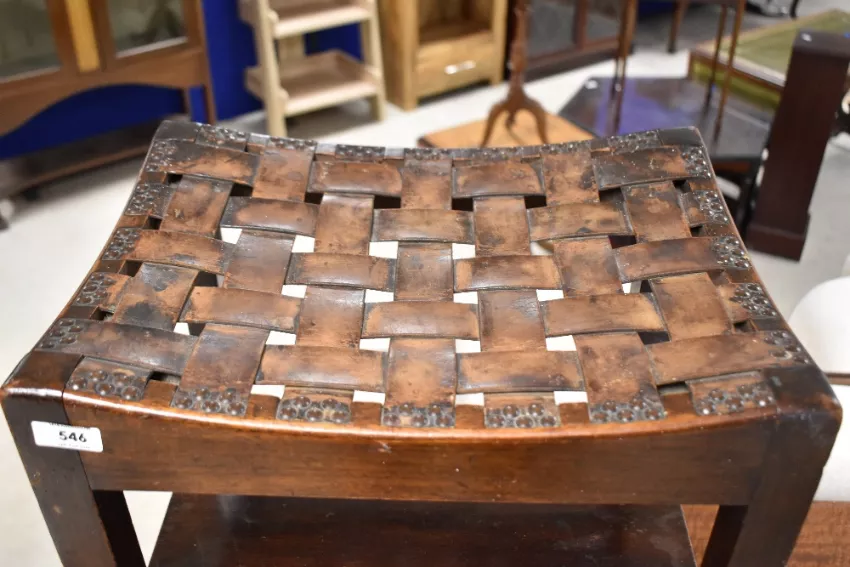
Arthur William Simpson (1857–1922) was a native of Kendal in Cumbria and a significant but often overlooked figure in the English Arts and Crafts movement.
Simpson’s life and work tell the story of a craftsman deeply invested in the belief that the beauty of an object should flow from its material and making. Born into a Quaker family, he trained through apprenticeships in woodcarving— including with the prestigious firm Gillow of Lancaster—Simpson returned to his hometown in 1885, where he founded what became known as The Handicrafts, a workshop and showroom in Kendal that would produce high-quality furniture and woodwork for more than half a century.
Simpson’s early work combined skills in ecclesiastical carving with finely made domestic furnishings, reflecting both his training and the influence of the wider Arts and Crafts ethos. His pieces ranged from carved panels and cabinetry to chairs and stools, all emphasising traditional craftsmanship, natural materials and simple yet refined design. A breakthrough came in 1889 when his work was selected for the London Arts and Crafts Society Exhibition, helping establish his reputation beyond the Lake District.
The workshop became a family enterprise, with Simpson’s wife, Jane, turning her hand to embroidery and other textile arts, and their daughter, Hilda, contributing delicate lacework, while his sons apprenticed under his guidance. Simpson also taught woodcarving in evening classes and at his summer studio near Bowness, reflecting his commitment to passing on craft skills. His work attracted local and regional admiration, and although he never gained the same international renown as some of his contemporaries, he remains respected among collectors and scholars of British craft furniture. The firm exhibited nationally and also held a showroom in Windermere, collaborating with notable figures such as architect Charles F. A. Voysey.
After Simpson’s death in 1922, the workshop continued under his son until 1950, when changing tastes and economic pressures led to its closure. Today, Simpson’s furniture and craftsmanship are prized by collectors and celebrated as an enduring legacy of British Arts, with original examples appearing regularly in our auctions.
To fully appreciate Simpson’s work, it helps to understand the broader Arts and Crafts movement. Born in the late 19th century as a reaction against industrialisation and mass production, the movement advocated a return to handicraft, traditional techniques, and a unity between design and making. It emerged out of the writings and leadership of figures like William Morris and John Ruskin, emphasising that the creative process was itself a moral pursuit and that everyday objects should be both beautiful and useful.
Simpson was part of a larger constellation of designers and makers across Britain who embraced these ideals. Some of his peers were well known in their own right: Charles Voysey, an architect and designer whose furniture and home interiors epitomised the Arts and Crafts aesthetic; Hugh Baillie-Scott, an influential designer of domestic architecture and interiors; and members of the Art Workers’ Guild, a society committed to the principles of craftsmanship and artistic integrity—Simpson himself was elected a member in the early 20th century.
While Simpson might not be as famed as Morris or Voysey, the continued demand for his work among collectors and the inclusion of Simpson furniture in exhibitions (such as at Blackwell, the Arts and Crafts House in the Lake District) confirm his lasting impact on the craft tradition. The pieces he created—simple yet elegant, proudly handcrafted and honest in material—embody the movement’s core ideals.
Others, like John George Sowerby, worked more on the decorative side, bringing Arts and Crafts principles to areas such as glass design and floral painting, demonstrating how far-reaching the movement’s influence was across materials and disciplines.
Today, scholars and enthusiasts of the Arts and Crafts movement regard Simpson and his contemporaries as central to understanding how craft became a form of cultural critique in late-Victorian and Edwardian Britain—championing beauty, utility, and the hand of the maker against the rising tide of industrialisation.
In the centuries since, their influence persists in furniture design, woodworking, and craft education, inspiring modern artisans to blend tradition and creativity in ways that remain true to the movement’s enduring spirit.