
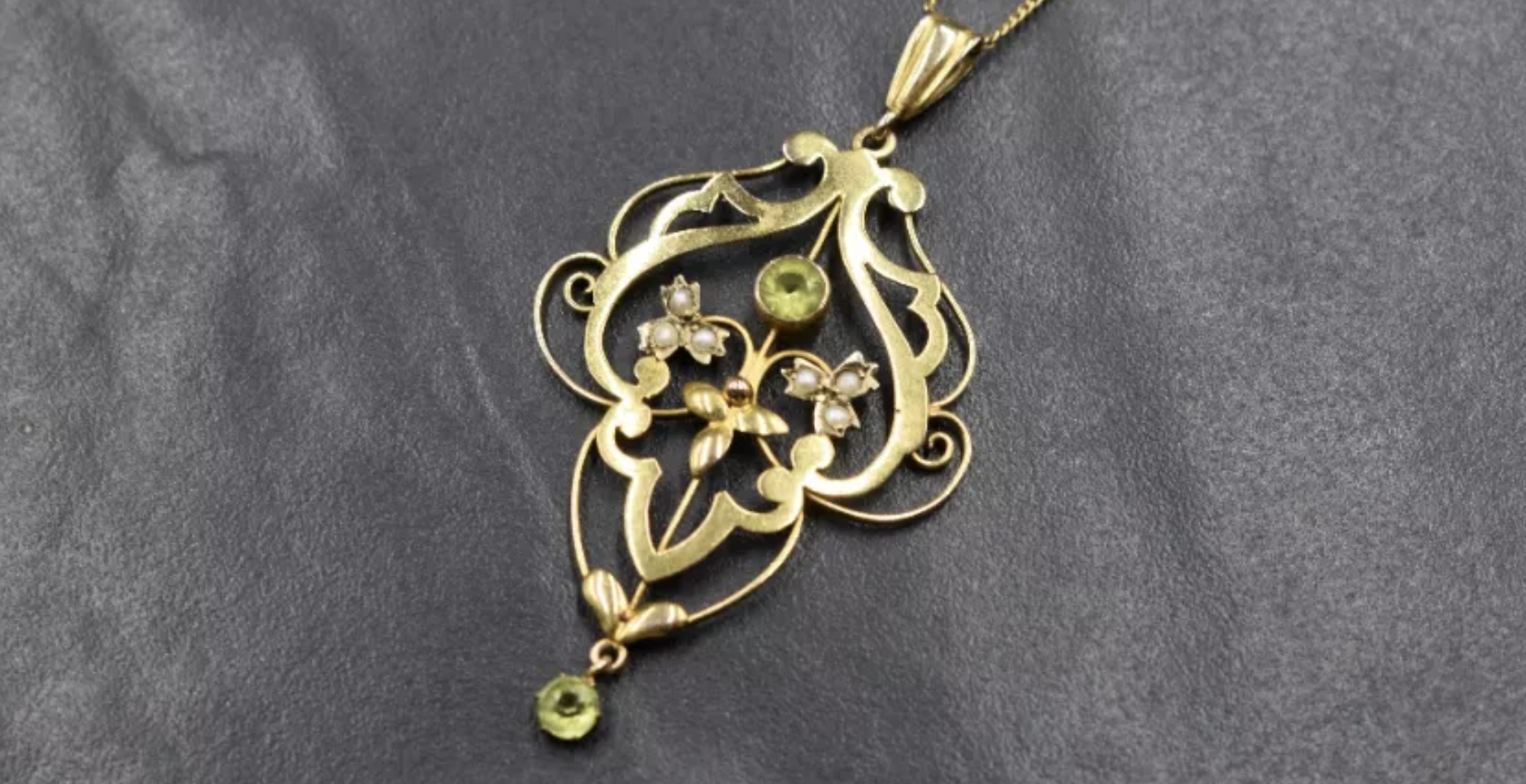
Edwardian pendants are named after the reign of King Edward VII, 1901 to 1910, and sit at the crossroads between Victorian heavy, symbolic pendants and the more modern, lighter look that came with the Art Nouveau & Art Deco periods.
Edwardian jewellery is all about delicacy, thanks to the advances in metalworking at the beginning of the 20th Century. This was especially due to the increased use of platinum, because of its strength, jewellers could suddenly create fine, lacy-looking designs which would have been impossible earlier. Pendants could become airy, light, open and floaty rather than chunky and heavy as was fashionable in the 19th Century.
One of the most iconic and popular Edwardian pendant styles is the Lavaliere, which usually features a small drop hanging from a graceful, delicate chain, the drop often being set with diamonds, pearls, peridots or amethysts. The proportions always being elegant and delicate. A typical lavaliere necklace might have a tiny diamond cluster at the top with a pear-shaped pearl drop, all with a fixed chain. They were designed to catch the light during the evening but also to flatter high lacy necklines during the day.
Diamonds became very popular during the Edwardian era. This being partly due to improved diamond cutting techniques and an increased supply being available from South Africa. Edwardian pendants often contain Old European cut diamonds which have larger facets and a softer shine compared to modern brilliant cut stones. Combined with the cool colour of platinum the effect was refined and elegant.
Pearls were the other big star of the era. Natural pearls were rare and expensive so were seen as status symbols, but used with such delicacy. Seed pearls were often woven into intricate patterns, outlining scroll, bow or garland designs. A lot of the Edwardian era pendants were of garland style designs having floral swags, ribbon or symmetrical curve detail, all very flowing, pretty pieces.
Stylistically, Edwardian pendants reflect a society that was graceful and orderly. Pieces were made, often with a strong sense of symmetry, but also very ornate and decorative. Edwardian pendants never bear the heaviness of Victorian mourning pieces that were so fashionable less than fifty years earlier. They would also be very different to the dramatic experimental designs that would evolve later.
Edwardian pendants are still very popular today as they are still very wearable. Despite the fact that they are over a hundred years old, many Edwardian pendants can still look surprisingly modern. They are light and delicate enough to wear every day or elegant enough to finish off an outfit for a formal occasion. They are usually exquisitely made, pretty pieces that are so subtle that they don’t scream ‘antique’ whether worn with a polo neck sweater or an elegant evening dress, unless you are aware of this style of pendant.
Edwardian pendants were often given as love tokens, whether for engagements, anniversaries or just as a loving gesture. They were often designed personally as a romantic gift from a wealthy gent with time and money to treat his partner. Because of this, the beautifully designed pieces are often still found in their original boxes and in fabulous condition as they have been kept and passed down as treasured family pieces.
Modern day collectors love Edwardian pendants not just for their beauty but also for their craftsmanship, often handmade and with incredible detail.
They can be found and added to your jewellery collection from many places, including antiques fairs, specialist second hand jewellery dealers or on-line market places including eBay, Vinted or Etsy. Or buy on line from auction houses, not only the big national auction houses such as Christies & Sotheby’s that sell high value items, but look at the smaller regional auction houses that often have hidden gems, lower fees, great customer service and still ship all over the world. 1818 Auctioneers in The Lake District is a great example of this as they regularly receive and sell beautiful Edwardian jewellery.
So, whether you find your beautiful Edwardian pendant in a dusty case on a jewellery stand at an antiques fair, in an antique shop or after the thrill of bidding and winning at an on-line auction you will love your new antique treasure.