
Whitefriars Glass is a colourful collectable, popular to specialist collectors and buyers who want to bring flare and class of 20th century design into their homes. It stands as one of the most celebrated names in British glassmaking, renowned for its quality and distinctive style. The origins of Whitefriars Glass dates back to the late 1600s, the name “Whitefriars” comes from the historic area in London where the glassworks were originally located near Whitefriars just off the River Thames. In the 19th century, the firm came under the control of James Powell & Sons, a wine maker and entrepreneur, who purchased the glassworks in London for his three sons. Under their leadership, the company kept up to date with the changing design movements of the era. The workshop became particularly known for stained glass, contributing to major ecclesiastical and architectural projects across the UK, supporting the mass construction of churches during the Victorian era.
In 1875 Harry James Powell, grandson of James Powell, joined the firm. A chemistry graduate from Oxford university, his training led the firm to further scientific production. Innovations such as a new colours and heat-resistant glass meant that the firm went onto produce for the science industry including light bulbs and X-ray tubes. As time went on, the firm took part in major exhibitions around the world and due to these opportunities foreign designs were copied from historical Venetian and Roman glass found in European museums and art galleries. The firm’s name was changed to Powell & Sons (Whitefriars Ltd) in 1919, and the business’ growth demanded a large operational premises. In 1923 a new factory was opening in Wealdstone, at the centre of the London borough of Harrow. It was here that Whitefriars came to make Arts and Crafts and Art Noveau glass for leading designers of the age.
The process in which Whitefriars glass was produced was labour-intensive and relied heavily on the skill of experienced glassworkers rather than automation. It began with a mixture of sand, soda ash and lime, the basic ingredients to create glass. This mixture was then melted in a furnace at temperatures exceeding 1,000 degrees Celsius, a glassblower would dip a long hollow metal pipe (blowpipe) into the molten glass enquiring precision to ensure the correct amount of the mixture was collected for the piece they were forming. The glass was then shaped through various methods such as flattening and stretching. One of Whitefriars’ defining features was its textured surfaces, the hot glass would be pressed or blown into moulds with deep patterns. Any further shaping would be done by hand once the glass was removed from the mould. The finished piece was placed in an annealing oven, where it cooled slowly over several hours. Post cooling, all pieces were individually inspected for any issues, final finishing could be done at this stage, but many Whitefriars pieces retained small irregularities because of its handmade production.
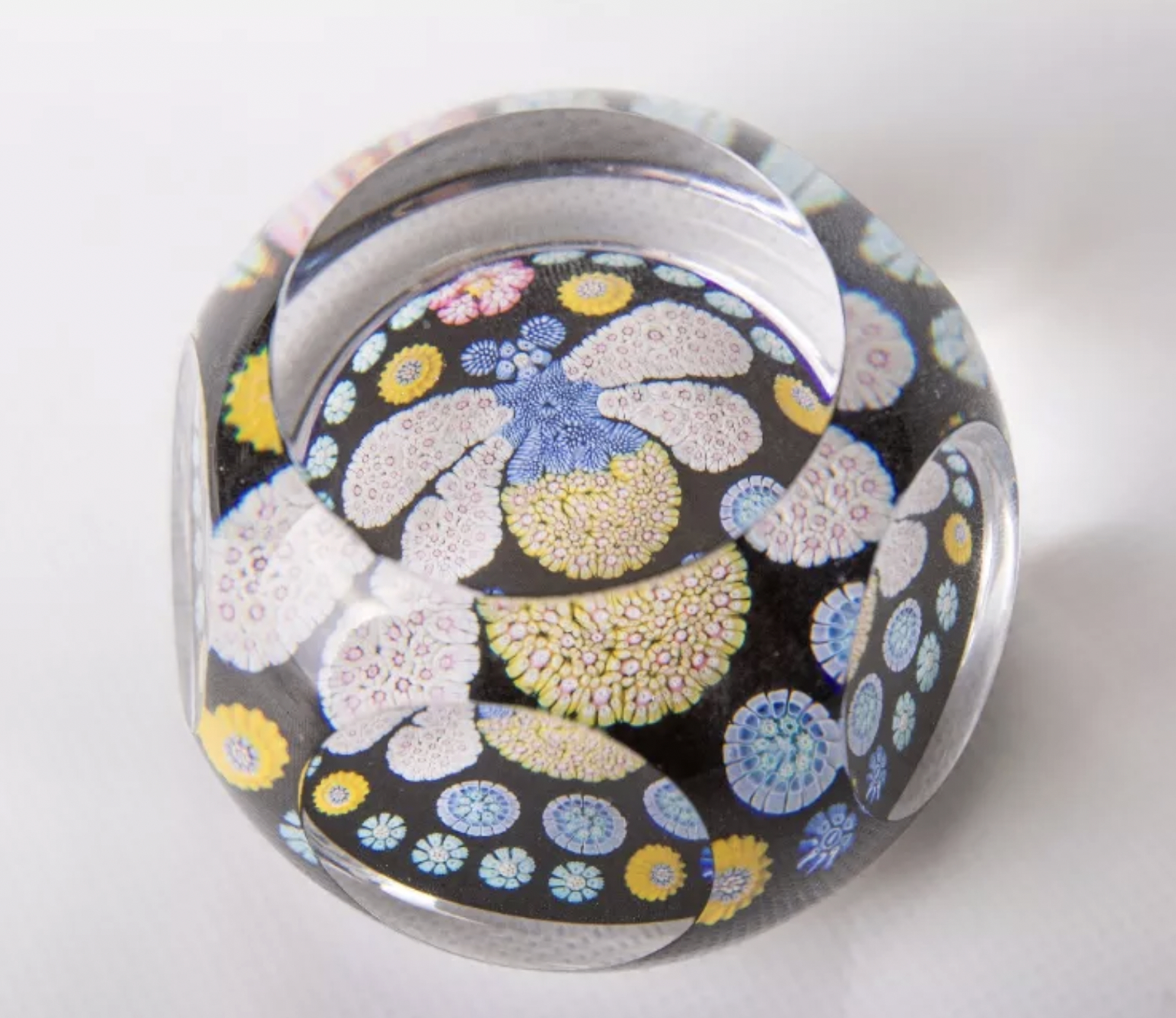
In the 1930s the firm began producing millefiori paperweights, characterised by shallow domes and wide bases. This period of success ended with World War II demanding aid to the country’s war efforts, meaning the likes of glass manufacture was restricted. By the end of the war the company, like many others, was struggling to survive. During the 1951 Festival of Britain, the British economy was recovering. In 1954 Geoffery Baxter joined the firm, a former student of the Royal College of Art, obtaining a first-class degree. He separated his style from the traditional and began to experiment famously using nails, wire, and bark to aid the creation of prototype models. His work featured vibrant colours, geometric patterns, and heavily textured surfaces, reflecting the spirit of post-war modernism.
With the factory officially re-branding as Whitefriars Glass in 1963, the late 1960s saw the release of the textured glass range featuring no well-known pieces such as ‘Bark’, ‘Banjo’ and ‘Drunken Bricklayer’ these pieces became highly collectible and remain sought-after today.
Baxter stayed with Whitefriars Glass until production ceased in 1980, struggling financially in the late 20th century. Due to changing market conditions, increased competition, and the decline of traditional manufacturing in Britain all contributed to its inevitable closure. This closure marked an end of an era, but Whitefriars influence did not end with it as through museums, collections, and admiration of those who appreciate the artistry of fine glass collectibles. Today Whitefriars Glass is a symbol of craftmanship, creativity and timeless design leading to it being highly sought after, pieces from the 1960s and 70s featuring a lot of work by Geoffery Baxter, can fetch significant prices at auctions and antique markets.