
In our modern lives, we are surrounded by things designed to be temporary. We live in an era that can, at times, feel rather disposable, a world where technology is updated almost daily, micro-trends shift monthly, and furniture is often built to last only as long as a one-year rental agreement.
Perhaps this is why our salerooms at 1818 Auctioneers feel so different; they offer a necessary reprieve from the digital, the temporary, or the flat-pack fatigue of the twenty-first century. When you step into the 1818 Auctioneers, you find yourself increasingly drawn back to the heavy, the tactile, and the weathered. We find ourselves, almost instinctively, drawn to real things.
As a valuer, while I am cataloguing a new sale, I often find myself musing over the “material culture” of the items sitting on my desk. This is the idea that objects are not just passive matter, but active participants in the human story. They act upon us. They demand our attention, evoke our memories, and, most importantly, serve as a “living,” tangible link to lives that looked very different from our own.
To understand how an object truly ‘acts’ upon us, one needs only look at Victorian magic lantern slides, which I have encountered quite a lot recently, and I find this so wonderful. Today, if we want to capture a sunset, a pet, or a gathering of friends, we simply tap a screen. The process is instantaneous, digital, and requires almost no physical exertion. But to hold a hand-painted glass lantern slide from the nineteenth century is to hold an entirely different kind of moment. Consider the sheer density of human labour trapped within that single fragment of glass. There is the glassblower who formed the plate, the chemist who prepared the light-sensitive pigments, and the artist who, working under a magnifying lens, painstakingly painted a miniature world. When that slide was eventually placed into the mahogany body of a lantern, it required the literal heat of a limelight or an oil lamp to breathe life into the image.
When you handle that slide today, you are not just looking at a picture; you are interacting with a physical survivor of that entire alchemical process. The slide demands something of you. You must hold it by its edges to avoid fingerprints; you must be mindful of its fragility; you must find a light source to unlock its true visual potential. Unlike the digital photo, which exists everywhere and nowhere at once, the lantern slide is an arrested moment. It is a mouthpiece for a vanished social and artistic history, forcing us to slow down to its pace and re-aligning our modern senses with a more intentional era of art, photography and materiality.
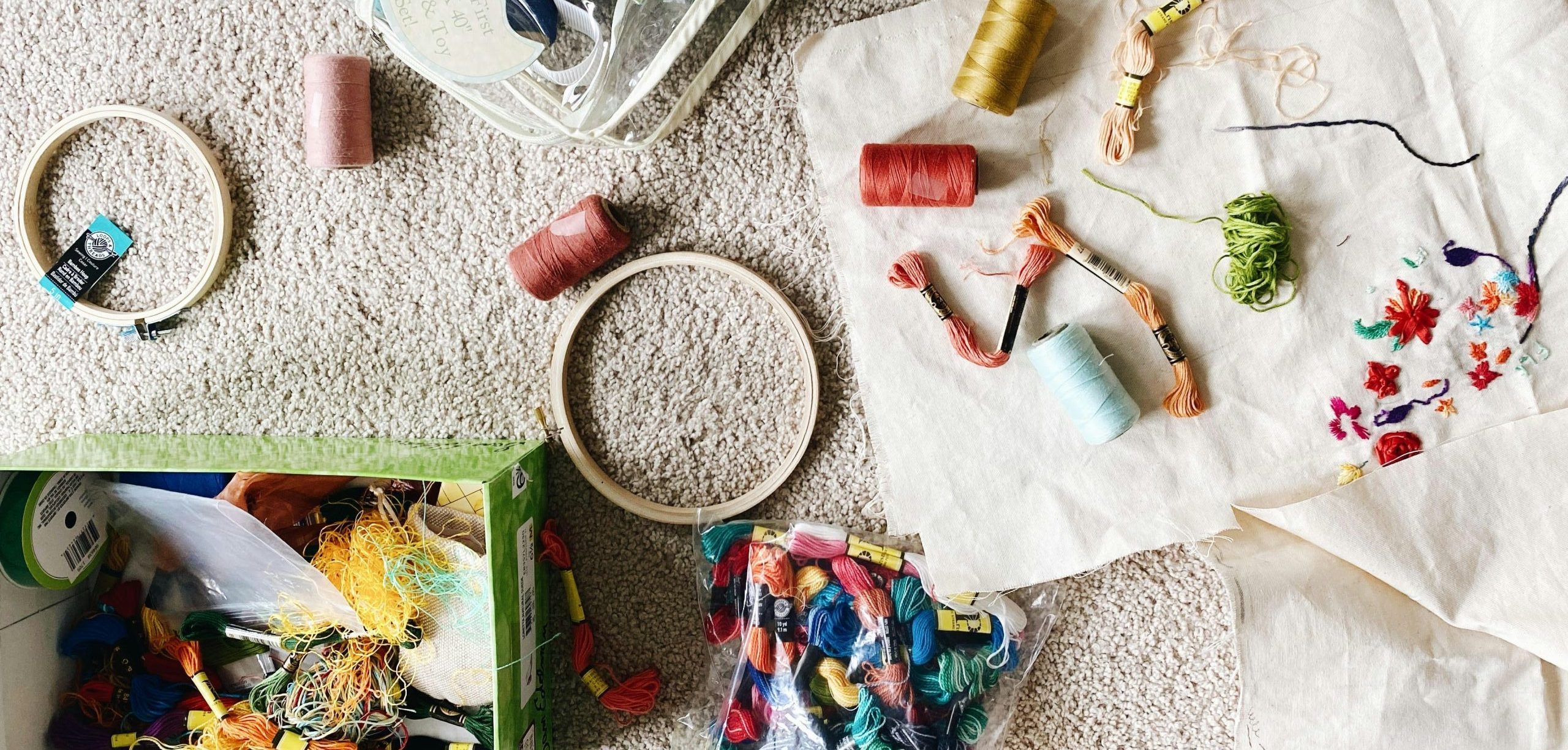
Furthermore, few objects are as poignant to me as the traditional sewing box. Perhaps this is because it represents a craft I have been close to my entire life, from re-hemming my own clothes and fixing second-hand finds to sewing buttons back on for friends who are a little unsure of where to place the needle. To many, a sewing box is simply a decorative wooden chest, perhaps with a fine marquetry inlay or the frayed remnants of a silk lining. But when you lift the lid, the object begins to speak. Inside, you find a world of ‘notions’, a term that beautifully suggests the thoughts, whims, and intentions of the maker.
I find there is something profoundly touching about discovering a sewing box still filled with its original contents: a tangled nest of silk threads, needles, and small thimbles. Frequently, I come across the remains of a “work in progress”, a piece of embroidery half-finished, or a collection of odd buttons that I imagine were intended for a garment that has long since disappeared. They represent a possible Tuesday afternoon a hundred years ago, fifty years ago, or even within my lifetime, when someone was called away from their task and never returned to it. Was it a sudden chore, a knock at the door, or simply the gradual fading of eyesight that left the needle exactly where it sits today?
In that unfinished project, we find a bridge to a person’s daily labour, unlike the curated, “perfect” versions of life we see on social media, the sewing box preserves the messy, tactile reality of the past, present and future. It acts upon us by forcing us to wonder about the hands that last held that needle.
If the sewing box represents the labour of the home, the writing slope represents the labour of the mind. These portable desks were almost the “laptops” of the nineteenth century, the essential tool for anyone who wished to stay connected in an age of slow travel and long-form correspondence. A fine writing slope, with its leather-lined surface and brass-bound corners, is a masterpiece of
compact design, yet its true power lies in its hidden spaces. I often discover slopes that still contain the ghosts of their former lives: glass inkwells with a crust of dried black ink at the bottom, or a stray, unused postage stamp tucked into a secret drawer and forgotten for a century. To open one of these hidden compartments is to feel like an interloper in a private world. The slope acts as a mouthpiece for a time when communication required patience, physical effort, and a certain gravity.
The dried ink is a physical reminder of the “labour of the letter”, the scratching of the pen, the blotting of the paper, and the careful folding of the page. When we handle these items today, they ground us. They remind us of a world that moved at the speed of a horse and carriage, urging us to consider the weight and value of the words we send into the world. Personally, I think there is still no better feeling than receiving a handwritten letter in the post, from a friend who lives abroad or from family who live in a different place to you.
Why do we find these things in our homes today? Perhaps it is because, in a world that can feel increasingly hollow and mass-produced, these objects offer us something real. They offer a direct connection to the human hand and the human heart. When you buy a piece at auction, you aren’t just buying “stuff.” You are becoming the next steward of a story. You are taking responsibility for that unfinished embroidery, that unused stamp, or the hidden history captured within a magic lantern slide.
At 1818 Auctioneers, my role is to listen to these objects and ensure their stories are heard. We invite you to look at the items in your own cupboards, drawers, and attics, not just as “vintage” or “antiques,” but as fragments of a life lived. If you have an object that feels like it has a story to tell, we would love to help you find its next chapter. After all, the most interesting thing about history is that it is still very much alive, waiting to be touched, held, and remembered.
Freya Lomas, Junior Cataloguer/Valuer