
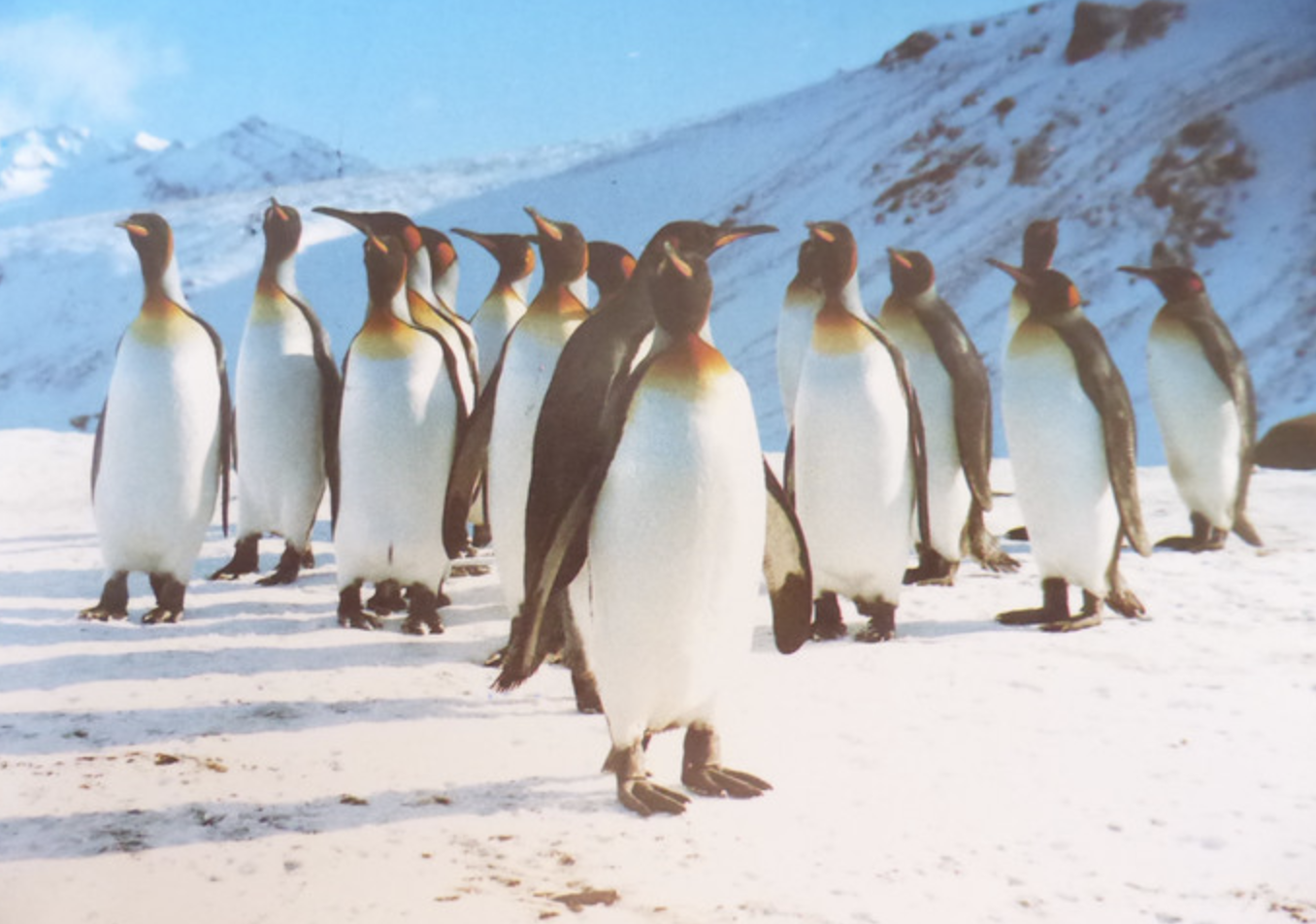
Specialist Valuer Andy Bowden looks at the remarkable postal history of South Georgia, where stamps and postmarks tell a wider story of exploration, sovereignty and life at the edge of the world:
“The sub-Antarctic islands of South Georgia are a Dependency of the Falkland Islands. It rises 3,000m above sea level and is entirely mountainous with numerous glaciers. The lower slopes support grass tundra vegetation, and the rugged coasts are notable for prolific birdlife and seals.
“The Spanish ship ‘Leon’ is generally credited with discovering South Georgia in 1756, though Antonio de la Roche may have sighted the island in 1675. The first landing, though, was by Capt. James Cook, who took possession for King George III in 1775.
“Following Cook’s account of the discovery, numerous sealing expeditions worked South Georgia between 1778 and 1820. Shore-based whaling began with the establishment of a whaling station by Cia. Argentina de Pesca in 1905. Subsequently, Norwegian and British companies also operated on the island. The trade continued through to 1965. At its peak, the transient male population reached around 2,000 during the summer whaling season.
“The Islands have been a port of call for several notable Antarctic expeditions. The Russian expedition of 1819-21 led by Thaddeus Bellingshausen included the island in its circumnavigation of the Antarctic continent and extended Cook’s survey. In 1882/3, the German International Polar Year Expedition (K. Schrader) wintered at Royal Bay and made scientific observations. The Swedish South Polar Expedition of Otto Nordenskiöld spent the winter of 1902 at South Georgia, among others.
“The Islands played a dramatic part in Sir Ernest Shackleton’s British Imperial Trans-Antarctic Expedition of 1914-16. After the ice of the Weddell Sea trapped and crushed ‘Endurance’, Shackleton led an epic voyage in an open boat from Elephant Island to South Georgia and made the first crossing of the island to seek help from the whalers at Stromness Bay. In 1921, Shackleton died at South Georgia during the Shackleton-Rowett (‘Quest’) Expedition. Between 1925-39 extensive hydrographic surveys and marine investigations were undertaken in the waters of the Falkland Island Dependencies from the Royal Research Ships ‘Discovery I’ and ‘Discovery II’.
“Postal facilities at South Georgia were provided after the Government Administration was established in 1909. For many years, until the Second World War, South Georgia stamps bore the Falkland Islands. However, in the 1940s, Operation Tabarin was set up. Tabarin responded to perceived threats of German naval activity in the Southern Ocean and to attempts by Chile and Argentina to assert sovereignty over the islands. A team of 14 men, Royal Navy Party 475 (RN475), was sent with the task of forming a programme of scientific work; however, one of the primary aims was rather more political, and was to establish Post Offices at each base and Island, as the use of the Post Offices was enough to accept proof of Sovereignty. Ultimately, many of the bases would receive cancellations of their stamps by Base, followed by a letter, for the likes of South Georgia, Graham Land, South Shetlands, etc. The early FID’s that had set these operations up later became part of the British Antarctic Survey (BAS)
“Stamps of South Georgia were produced, up to the 1970’s and most parts of the region then became part of the British Antarctic Territory (BAT), however South Georgia still remained a dependency of the Falklands at the time. With the 1985 constitution, it ceased to be a dependency and now issues its own stamps under the name South Georgia & Sandwich Islands. For collecting, it’s a relatively inexpensive territory, and with issues from 1986 onwards also modern in nature, many of their designs represent island life and explorers and ships, so if you love penguins, then this would be one of the places to start!
“One of the biggest problems will be getting fine used material (not on a first day cover) with those postmarks from the end of the world! They are few and far between, but as is the case with stamp collecting, that is part of the thrill of the chase!”